When your vehicle's airbags deploy, it is a clear indicator of a significant impact. This event triggers a complex series of necessary repairs that go far beyond simple cosmetic fixes. Handling airbag deployment damage is a meticulous process that requires specialized knowledge of your car's Supplemental Restraint System (SRS). This system includes not only the airbags themselves but also a network of sensors, control modules, and seatbelt pre-tensioners that all work together. A professional collision repair shop understands that restoring your vehicle is about more than just replacing the deployed bag; it is about ensuring the entire safety system is fully functional and ready to protect you in a future incident. The process involves detailed diagnostics, component replacement with high-quality parts, and precise recalibration to meet manufacturer specifications. Trusting this critical repair to experts is essential for your peace of mind and safety on the road.
The aftermath of an airbag deployment can seem overwhelming, but a systematic approach ensures nothing is missed. A certified technician's first step is always a thorough diagnostic scan to understand the full scope of the SRS activation. This reveals which components—from impact sensors to the central control unit—have been compromised. Simply replacing the visible airbag is never enough. The entire system must be carefully inspected and restored to factory standards to guarantee its reliability. This commitment to comprehensive repair is what distinguishes a quality auto body shop.
The Comprehensive Process of Repairing Airbag Deployment Damage
An airbag deployment is a violent, instantaneous event designed to save lives. The repair process that follows must be equally precise and thorough to restore that life-saving capability. Unlike many general auto repairs, fixing an SRS is a non-negotiable safety procedure that leaves no room for error. At a professional collision repair facility, this process is broken down into several critical stages, each one building upon the last to ensure a complete and safe restoration of your vehicle. From the initial electronic diagnosis to the final interior touches, every step is vital. For more on our initial process, learn about what happens during a collision repair estimate.
Step 1: Initial Diagnostic Assessment
The moment a vehicle with deployed airbags arrives at the shop, the first order of business is a deep dive into its electronic systems. Technicians connect a specialized diagnostic scanner to the vehicle's OBD-II port to communicate with the SRS control module. This computer is the brain of the safety system, and it records critical data during a collision, including which sensors were triggered and which components were activated.
The diagnostic scan reveals a list of fault codes that guide the repair plan. These codes confirm the deployment of specific airbags (driver, passenger, side curtain, knee, etc.) and also flag other compromised parts, such as seatbelt pre-tensioners and crash sensors. This step is crucial because many SRS components are hidden from view. A visual inspection alone is insufficient and could lead to an incomplete and unsafe repair. We encourage you to understand how auto body shops use diagnostic scans to ensure a complete repair.
Step 2: Identification and Sourcing of All Necessary Components
Once the diagnostic report is complete, the technician creates a comprehensive list of every part that needs to be replaced. This is often more extensive than customers realize. A single airbag deployment event typically requires the replacement of multiple items.
- Airbag Modules: Every deployed airbag must be replaced with a brand-new unit. Airbags are single-use devices and cannot be repacked or reused.
- SRS Control Module: The control module stores crash data that is often "locked" after a deployment. In most cases, manufacturers require this module to be replaced to ensure the system is free of any lingering data conflicts.
- Crash Sensors: The sensors that detected the impact and triggered the deployment are also single-use components and must be replaced. Their precise location depends on the area of impact.
- Seatbelt Assemblies: Modern seatbelts contain a pyrotechnic pre-tensioner that fires during a crash, pulling the occupant securely into their seat. Once this charge is fired, the entire seatbelt mechanism must be replaced.
- Interior Trim and Components: The force of an airbag deploying can destroy the panels that conceal it. This often includes replacing the dashboard, steering wheel cover, seat covers, or headliner.
Sourcing the right parts is essential. Reputable shops will insist on using Original Equipment Manufacturer (OEM) parts to guarantee perfect fit, function, and reliability. You can learn more about why OEM parts matter in collision repair on our blog.
Step 3: Structural and Mechanical Repairs
Before any new SRS components can be installed, the vehicle's structural integrity must be restored. Airbags only deploy in moderate to severe collisions, which almost always cause underlying structural damage. The SRS sensors rely on the vehicle's frame to correctly interpret the force and direction of an impact. If the frame is bent or misaligned, the sensors may not function as intended in a future accident.
Technicians will perform any necessary frame straightening or unibody repair to bring the vehicle back to its factory dimensions. This foundational work ensures that the new sensors will be mounted in their precise, original locations, which is critical for their proper operation. Ignoring this step is one of the biggest risks associated with cut-rate repair shops.
Step 4: Installation and System Integration
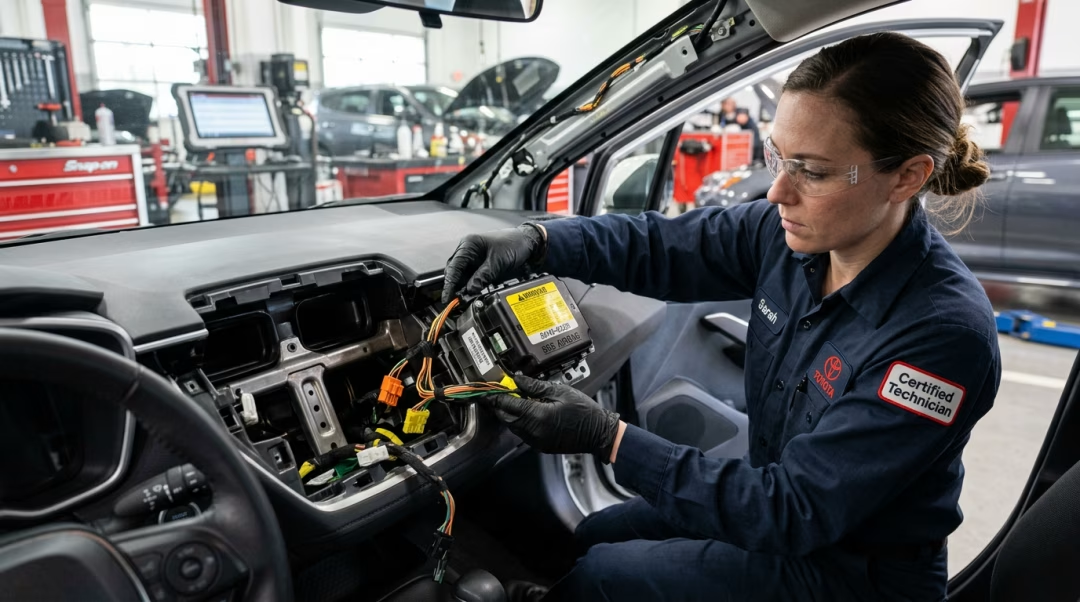
With the vehicle's structure sound and all necessary parts on hand, the installation process begins. This is a delicate procedure that requires adherence to the manufacturer's specific guidelines. Technicians will carefully disconnect the vehicle's battery to prevent any accidental discharge while working on the SRS.
They will replace the deployed airbags, the control module, sensors, and seatbelt assemblies. Wiring harnesses are carefully inspected for any damage from the impact or deployment and are repaired or replaced as needed. Once all hardware is installed, the interior components like the dashboard and trim are reassembled. The focus then shifts back to the electronic side, where the new system must be programmed and calibrated to the specific vehicle. This often involves using manufacturer-specific software to ensure all components are communicating with each other correctly. This is part of a larger process that includes a look at how collision repair shops restore vehicle safety systems.
Step 5: Final Testing, Calibration, and Quality Checks
The final step is arguably the most important: verification. After all parts are installed and the system is powered back on, the technician runs another full diagnostic scan. The goal is to confirm that there are no remaining fault codes and that the new SRS control module recognizes all the new sensors and airbags.
The SRS warning light on the dashboard should illuminate for a few seconds when the car is started and then turn off. If the light stays on, it indicates a problem somewhere in the system that must be addressed. A technician will perform a final road test and quality control inspection to ensure everything is working as it should. A post-repair inspection ensures the job was done right and your vehicle is safe to return to the road. This comprehensive approach is how we guarantee the safety and reliability of every repair we perform.
Can airbags be repacked or reused after they deploy?
No, absolutely not. Airbags are single-use safety devices. The chemical reaction that inflates the bag and the force of its deployment permanently destroys the airbag module. Attempting to repack an airbag is extremely dangerous and will result in a non-functional system. All deployed airbag modules must be replaced with new, OEM-certified units.
Why do my seatbelts need to be replaced if the airbags went off?
Modern seatbelts are part of the SRS and contain a component called a pre-tensioner. During a collision, this device uses a small pyrotechnic charge to retract the seatbelt, pulling the occupant firmly and safely into their seat. Once this charge has fired, the mechanism is spent and the entire seatbelt assembly must be replaced to ensure it will function in a future accident.
Will a repaired airbag system be as safe as the original one?
Yes, provided the repair is performed by a qualified, certified technician using the correct OEM parts and following the manufacturer's procedures. A properly restored SRS will be just as safe and reliable as the one that came from the factory. This is why choosing a reputable collision shop is critical for your safety.
How do collision technicians know which sensors to replace?
Technicians rely on two key sources of information. First, the vehicle's onboard diagnostic system will generate specific fault codes that point to the exact sensors that were activated during the impact. Second, a physical inspection helps identify any sensors that may have sustained visible damage from the collision itself.
Is the full cost of airbag system repair typically covered by insurance?
In most cases, yes. Airbag system replacement is considered an integral part of the collision repair process. If you have collision coverage, your insurance policy should cover the cost of restoring the SRS to its pre-accident condition, minus your deductible. For more details, you can read about how the auto body insurance claims process works.
