Have you ever wondered what holds your car together? For the vast majority of modern sedans, SUVs, and crossovers, the answer is a unibody structure. Unlike older body-on-frame designs, a unibody vehicle integrates the frame and the body into a single, cohesive shell. This engineering marvel makes cars lighter, more fuel-efficient, and safer by design, with built-in crumple zones to absorb impact energy during a collision. However, when this integral structure is damaged, repairing it is far more complex than simply fixing a dent. Unibody repair is a precise science that involves restoring the vehicle's foundational geometry to exact factory specifications. Understanding this process is crucial not only when your car needs collision work but also when you are evaluating a pre-owned vehicle from our inventory. A proper repair ensures your car is as safe and reliable as the day it was made.
The importance of correct unibody repair cannot be overstated. When this foundational structure is not perfectly realigned, it can lead to a cascade of problems. You might notice persistent alignment issues that cause uneven tire wear, doors that refuse to close properly, or inconsistent gaps between body panels. More critically, the vehicle's safety systems, including airbags and crumple zones, may not function as intended in a future accident. Essentially, the car's "skeleton" is compromised, affecting its performance, longevity, and, most importantly, its ability to protect you and your passengers.
The Foundation of Modern Vehicles: Understanding Unibody Construction
To truly grasp why unibody repair is so critical, it is essential to first understand the design itself. For decades, the standard for vehicle manufacturing was a body-on-frame construction. Think of this as a separate, heavy steel ladder frame that acts as the chassis; the engine, suspension, and wheels are attached to this frame, and the vehicle's body is then bolted on top. This method is still common for heavy-duty trucks and some large SUVs due to its ruggedness and towing strength.
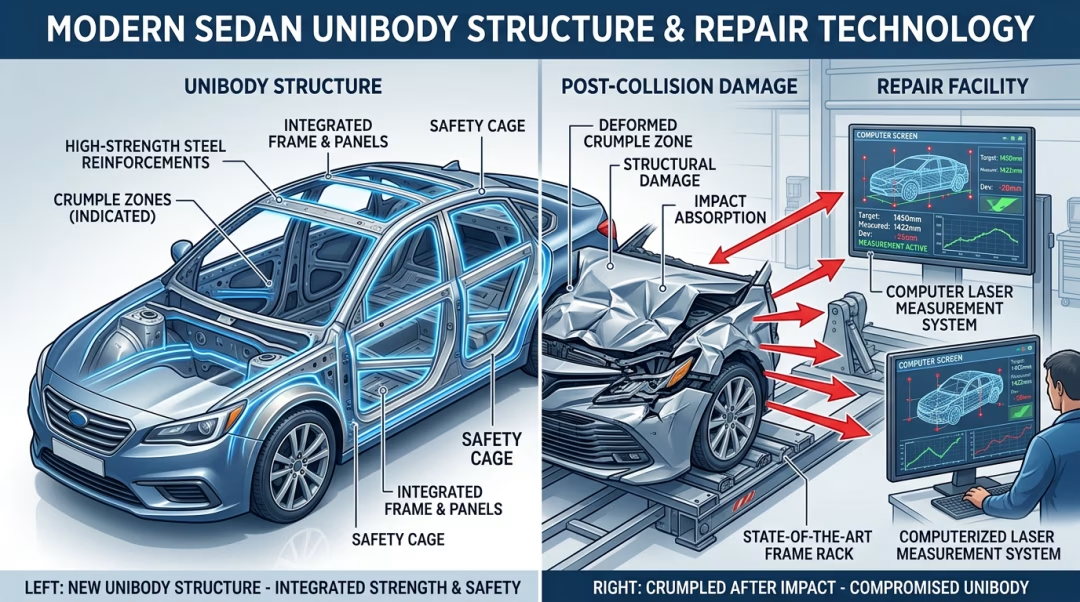
However, starting in the latter half of the 20th century, passenger cars increasingly shifted to unibody construction. In a unibody (short for "unitized body") design, the body of the vehicle and its frame are manufactured as a single, unified piece. The floor pan, pillars, roof, and other structural components are all welded together to create a rigid, shell-like structure. This shell serves as both the skeleton and the skin of the car. This innovative approach offers several distinct advantages:
- Improved Safety: Engineers can design specific areas, known as crumple zones, to deform and absorb impact energy in a controlled manner during a collision, directing forces away from the passenger cabin.
- Reduced Weight: By eliminating a heavy, separate frame, unibody vehicles are significantly lighter, which directly translates to better fuel economy and enhanced performance.
- Better Handling: The increased structural rigidity of a unibody provides a more stable platform for the suspension, resulting in more responsive handling and a smoother ride.
While these benefits make unibody cars safer and more efficient, they also mean that any structural damage must be addressed with surgical precision. The entire shell is an interconnected system, and a bend or twist in one area can affect the alignment and integrity of the entire vehicle.
The Intricate Process of Professional Unibody Repair
Repairing a damaged unibody is a world away from cosmetic fixes. It requires specialized equipment, extensive training, and an intimate knowledge of vehicle-specific manufacturing tolerances. A simple visual inspection is never enough; technicians must diagnose the full extent of the damage, which is often hidden. To learn more about this initial step, you can read about what a pre-repair damage inspection is.
The core of the repair process often involves a sophisticated piece of equipment known as a frame machine or frame rack. The damaged vehicle is securely anchored to this platform. Using a combination of hydraulic towers, chains, and clamps, technicians apply immense, controlled force to pull and push the twisted or compressed metal back into its original, pre-accident dimensions. This is not guesswork. The process is guided by computer-aided laser measuring systems that compare the vehicle's current state to the precise factory specifications, often demanding accuracy within a single millimeter. This complex procedure is detailed further in our guide on how frame straightening works.
In cases of severe damage, some sections of the unibody may be too compromised to be straightened. Here, technicians must follow manufacturer-approved procedures to cut out the damaged section and weld in a new replacement part. This ensures that the structural integrity is fully restored. Once the unibody is perfectly aligned, the final, crucial step is the reinstallation and recalibration of all related systems. This includes ensuring sensors and cameras are recalibrated after body repair, as many advanced driver-assistance systems (ADAS) rely on precise mounting points to function correctly.
Why Proper Unibody Repair is Non-Negotiable for Car Owners
Insisting on a professional, high-quality unibody repair is one of the most important decisions you can make after an accident. The consequences of a poor repair job extend far beyond aesthetics and can impact nearly every aspect of your vehicle.
- It Restores Critical Safety Features: Your vehicle's ability to protect you in an accident depends on its structural integrity. A properly repaired unibody ensures crumple zones will collapse as designed and that airbag sensors will trigger at the correct moment. An improper repair can turn these life-saving features into liabilities.
- It Maintains Driving Performance and Handling: Even a slight deviation in the unibody's structure can throw off the vehicle's suspension geometry. This is a primary reason for alignment issues after a collision, leading to the car pulling to one side, unpredictable handling, and accelerated wear on your tires and suspension components.
- It Prevents Long-Term Complications: A poorly repaired frame often results in body panels that never quite fit right. This can cause annoyances like doors that are difficult to close, wind noise at high speeds, and water leaks that lead to rust and mold. You can learn more about how technicians inspect for water intrusion after damage to prevent this.
- It Protects Your Vehicle's Resale Value: Savvy buyers and dealerships know how to spot signs of shoddy repair work. A vehicle history report indicating structural damage can be a major red flag, but when it is backed by certified documentation of a professional repair, it provides confidence and helps in protecting your vehicle's resale value.
Whether you are dealing with an insurance claim or looking to purchase a used car, never underestimate the importance of the unibody. It is the foundation upon which your vehicle's safety, performance, and value are built. For more information on our commitment to quality vehicles, please visit our about us page.
Is a car with previous unibody repair safe to drive?
Absolutely, provided the repair was performed correctly by qualified technicians using the proper equipment. A professionally repaired unibody is restored to its original factory specifications for strength, alignment, and safety. The key is the quality of the repair work.
How can I tell if a used car has had unibody damage?
Look for signs like uneven gaps between body panels (hood, doors, trunk), paint overspray on window seals or trim, doors that do not open and close smoothly, and uneven tire wear. The best way to be certain is to obtain a vehicle history report and have a trusted mechanic perform a pre-purchase inspection.
How is unibody repair different from frame straightening?
The terms are often used interchangeably, but "frame straightening" is the specific process of correcting a bent frame, while "unibody repair" is the overarching term for restoring a vehicle with an integrated body and frame structure. Since a unibody is a single piece, straightening it is a highly complex process that is just one part of the overall structural repair.
Does unibody damage automatically mean the car is a total loss?
Not necessarily. An insurance company declares a car a total loss when the cost of repairs exceeds a certain percentage of the vehicle's actual cash value. Many vehicles with moderate unibody damage can be safely and economically repaired. The decision depends on the severity of the damage, the vehicle's age, and its value.
Will my car ever feel the same after unibody repair?
Yes, that is the ultimate goal of a proper repair. When a vehicle's unibody is returned to its exact pre-accident dimensions, and all suspension and steering components are correctly aligned, it should drive, handle, and feel exactly as it did before the collision. Any lingering issues with handling or alignment indicate an incomplete or improper repair.
