After an accident, the path to restoring your vehicle involves many critical decisions. One of the most important choices revolves around the parts used in the repair process. You will likely encounter two main options: Original Equipment Manufacturer (OEM) parts and aftermarket alternatives. While aftermarket parts can sometimes seem like a cost-effective solution, understanding the profound differences is essential for your vehicle's safety, performance, and long-term value. OEM parts are engineered by your vehicle's maker, for your specific vehicle. This ensures they meet the same rigorous standards for fit, finish, durability, and safety as the ones installed on the factory floor. Opting for genuine parts is not just about aesthetics; it is a crucial investment in preserving the structural integrity and advanced safety systems that are designed to protect you and your passengers. Choosing wisely ensures your repair is not just a quick fix but a true restoration.
Ultimately, the parts used in your vehicle's repair define the quality and safety of the final result. Insisting on OEM parts means you are choosing factory-level precision, guaranteed performance, and unwavering safety compliance. These components work seamlessly with your car’s complex systems, from sensor calibration to airbag deployment timing. By prioritizing OEM parts, you are not just repairing damage—you are protecting your investment, ensuring your warranty remains intact, and, most importantly, upholding the safety standards your vehicle was designed to meet from day one.
The Unseen Difference: A Deep Dive into OEM Parts for Collision Repair
When your car is in the shop for collision repair, your primary concern is getting it back to its pre-accident condition. You want it to look right, drive right, and be just as safe as it was before the incident. The key to achieving this lies in the quality of the components used to replace damaged ones. The debate between Original Equipment Manufacturer (OEM) and aftermarket parts is central to this process, and the choice has significant implications that go far beyond the surface. Understanding why OEM parts are the superior choice is fundamental to ensuring a quality, lasting repair.
An OEM part is a component produced by your vehicle’s original manufacturer or the company that supplied it to them for factory assembly. These parts are, for all intents and purposes, identical to the ones your car was built with. They are designed using the same blueprints, molded from the same materials, and subjected to the same stringent quality control and safety testing. When you use an OEM part, you are restoring your vehicle with a component that the manufacturer has certified to perform exactly as intended for your specific year, make, and model.
The Alternatives: Understanding Aftermarket and Salvaged Parts
To appreciate the value of OEM, it is helpful to understand the alternatives. Aftermarket parts are produced by third-party companies. These companies reverse-engineer the original parts to create their own versions. While some aftermarket parts are of high quality, their standards can vary dramatically. There is no single governing body that ensures they meet the same safety, material, or fitment specifications as the original manufacturer. Furthermore, you might be curious about what to expect when repairing a vehicle with aftermarket parts, as the results can be unpredictable. Salvaged, or recycled, parts are taken from other vehicles, often from a junkyard. While technically OEM, their history is unknown, and they may have been exposed to stress, weather, or unseen damage that compromises their integrity.
Guaranteed Fit and Flawless Finish
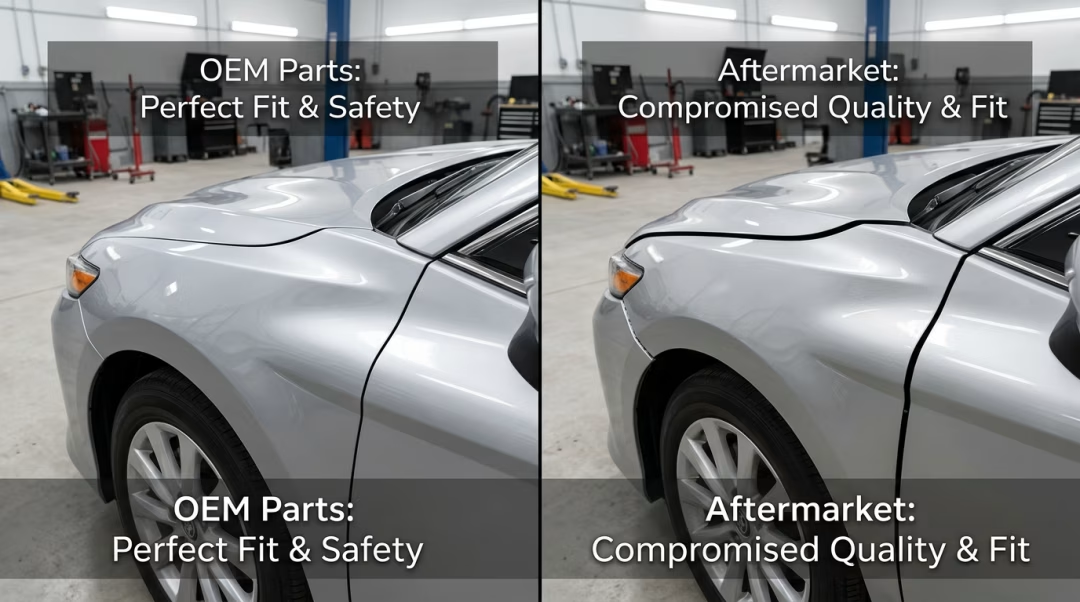
One of the most immediate benefits of using OEM parts is the perfect fit. Because they are made from the original tooling, they align precisely with your vehicle's body, mounting points, and adjacent panels. This eliminates issues with unsightly gaps, poor alignment, and difficult installation that often plague aftermarket parts. A technician using an OEM part doesn't have to spend extra time bending, cutting, or forcing a component into place. This precise fit is not just about looks; it ensures that everything from your headlights to your bumper functions as a cohesive unit. A poor fit can lead to chronic problems, and it's important to understand what causes panel gaps after a poor repair job, which is often the use of inferior parts.
- Identical materials and construction to factory originals.
- Guaranteed to fit without modification or forcing.
- Undergoes the same safety testing as your original vehicle.
- Preserves your vehicle's original factory warranty.
The Non-Negotiable Factor: Vehicle Safety
Your vehicle's body and structure are not just for show; they form a complex safety system designed to absorb impact and protect occupants during a collision. Automakers invest billions in research and development to perfect crumple zones, material strength, and component behavior in a crash. OEM parts are manufactured to replicate this performance exactly. Aftermarket parts, however, may not be. They might be made from thinner steel, use different bonding agents, or lack the specific design characteristics that allow them to crumple and absorb energy correctly. Using a non-OEM bumper reinforcement or fender could alter how your vehicle behaves in a subsequent accident, potentially compromising the safety of everyone inside. That is why it's so important to know how collision repair shops restore vehicle safety systems with the right components.
Compatibility with Advanced Driver-Assistance Systems (ADAS)
Modern vehicles are equipped with an array of sophisticated sensors, cameras, and radar units that make up the Advanced Driver-Assistance Systems (ADAS). Features like blind-spot monitoring, adaptive cruise control, and pre-collision braking rely on components being in their exact factory-specified locations. An aftermarket grille with slightly different dimensions or a bumper made of a material that interferes with radar signals can cause these systems to malfunction. Using OEM parts is the only way to ensure that these delicate systems can be recalibrated correctly. The process of how sensors and cameras are recalibrated after body repair is meticulous and depends on the geometric precision that only OEM parts can provide.
Protecting Your Investment and Resale Value
The value of your vehicle is significantly impacted by its condition and repair history. A documented repair using genuine OEM parts demonstrates a commitment to quality and helps maintain the car's market value. Conversely, evidence of repairs with ill-fitting aftermarket parts can be a major red flag for savvy buyers and professional appraisers, leading to a lower trade-in offer or sale price. By choosing OEM, you are actively participating in how collision repair protects your vehicle resale value. It's a decision that pays dividends when it is time to sell or trade in your vehicle. Insisting on OEM parts is one of the best ways to avoid a diminished value claim after an accident.
Navigating Insurance and Your Right to Choose
Insurance companies often encourage the use of aftermarket parts in an effort to control costs. Their estimates may specify non-OEM components, but in many states, you have the right to request genuine OEM parts for your repair. A reputable collision repair center will work with you and your insurance provider, advocating for the use of OEM parts by explaining their importance for a safe and proper repair. Understanding how to read a collision repair insurance estimate is your first step in ensuring your vehicle gets the quality components it deserves. Do not be afraid to ask questions and assert your preference for the parts that will best restore your vehicle's integrity.
Frequently Asked Questions About OEM Parts
What exactly is an OEM part?
An Original Equipment Manufacturer (OEM) part is made by the same company that manufactured the original parts for your vehicle. It is identical in every way—material, dimensions, and quality—to the part being replaced, ensuring a perfect fit and function as designed by your car's engineers.
Are aftermarket parts safe to use in collision repair?
The safety of aftermarket parts can be inconsistent. While some may perform adequately, they are not held to the same federal safety and crash-testing standards as OEM parts. Using them can potentially compromise your vehicle's structural integrity and the performance of its safety systems in a future collision.
Can my insurance company force me to use aftermarket parts?
While insurance policies vary, many states have laws protecting a consumer's right to choose their repair shop and, in many cases, the types of parts used. An insurance company may initially write an estimate with aftermarket parts to lower costs, but you can, and should, insist on OEM parts for a quality repair. A good body shop will help you navigate this process.
How do OEM parts affect my vehicle's resale value?
Using OEM parts helps maintain your vehicle's resale value. A repair history with genuine parts shows that the vehicle was restored to factory specifications. Conversely, poor-fitting aftermarket parts are easily spotted by appraisers and potential buyers, which can significantly lower your car's value.
Does using non-OEM parts void my vehicle's factory warranty?
Using an aftermarket part will not void your entire vehicle warranty, but it can cause issues. If that aftermarket part fails and causes damage to another component, the manufacturer may deny warranty coverage for that specific repair. Using OEM parts ensures that your vehicle's original warranty remains fully intact.
