After an accident, a vehicle's appearance is often the most obvious concern. However, beneath the dented panels and scraped paint lies a complex network of safety systems that are critical to your protection on the road. Modern vehicles are engineered with sophisticated technologies, from the structural integrity of the frame to the intricate sensors of Advanced Driver-Assistance Systems (ADAS). Restoring these systems is the most important part of any collision repair. A proper repair goes far beyond cosmetics; it involves a meticulous process of diagnostics, component replacement, and precise calibration to ensure every safety feature functions exactly as the manufacturer intended. This restoration is not just about fixing your car; it is about rebuilding your peace of mind and ensuring the vehicle is once again prepared to protect you and your passengers in any future scenario. Choosing a shop that understands this is paramount to a safe and successful repair.
Understanding the detailed steps a qualified collision repair center takes can empower you as a vehicle owner. The journey from a damaged state to a fully restored, safe vehicle involves much more than meets the eye. It combines advanced diagnostic technology with the hands on skill of certified technicians. From verifying the structural alignment to recalibrating the sensitive cameras and radar that enable modern safety alerts, every action is deliberate and crucial. This ensures that your car’s protective shell and its electronic guardian angels are working in perfect harmony once again.
Beyond the Surface: A Deep Dive into Safety System Restoration
When your vehicle is involved in a collision, the forces at play can compromise systems far from the point of impact. What might look like a simple bumper scuff could conceal a misaligned radar sensor, and a seemingly minor fender bender could affect the structural components designed to absorb energy. That is why professional collision repair is a science focused on restoring a vehicle to its pre-accident condition in both form and function. This process begins long before any paint is mixed or any panels are replaced. It starts with a comprehensive understanding of the vehicle’s integrated safety features.
The very first step in a modern repair process is a full diagnostic scan. As we detail in our guide on how auto body shops use diagnostic scans, this procedure allows technicians to communicate with your vehicle's onboard computers. It reveals a detailed report of any trouble codes stored in the system, including those related to the Supplemental Restraint System (SRS), anti lock brakes (ABS), and ADAS. This pre repair scan provides a crucial roadmap, identifying all affected electronic systems that require attention, many of which would otherwise go unnoticed.
Rebuilding the Foundation: Structural Integrity
A vehicle's primary safety feature is its structure. The frame or unibody chassis is engineered with specific crumple zones to absorb and redirect impact energy away from the passenger cabin. If this structure is compromised, all other safety systems may not perform as designed. Technicians use sophisticated, computer guided measuring systems to assess the frame's alignment down to the millimeter. If deviations are found, they employ specialized equipment to perform a frame straightening and pull the structure back to exact factory specifications. This process is fundamental because the precise placement of body panels, sensors, and suspension components all depends on a perfectly true foundation. Restoring this integrity is non negotiable for a safe repair.
Passive Safety: Restoring Airbags and Seatbelts
The Supplemental Restraint System (SRS), which includes your airbags and seatbelt pretensioners, is a one time use system. Once an airbag deploys, it cannot be reset or repacked. The entire module, including the inflator and the bag itself, must be replaced with a new, OEM component. The process also involves replacing crash sensors that were triggered and resetting or replacing the central SRS control module. Technicians meticulously follow manufacturer procedures to ensure every connection is secure and the system is armed and ready. Similarly, seatbelt pretensioners, which tighten the belts in a crash, must also be replaced after activation. This critical work ensures your vehicle's passive safety net is fully functional.
Active Safety: The Critical Role of ADAS Calibration
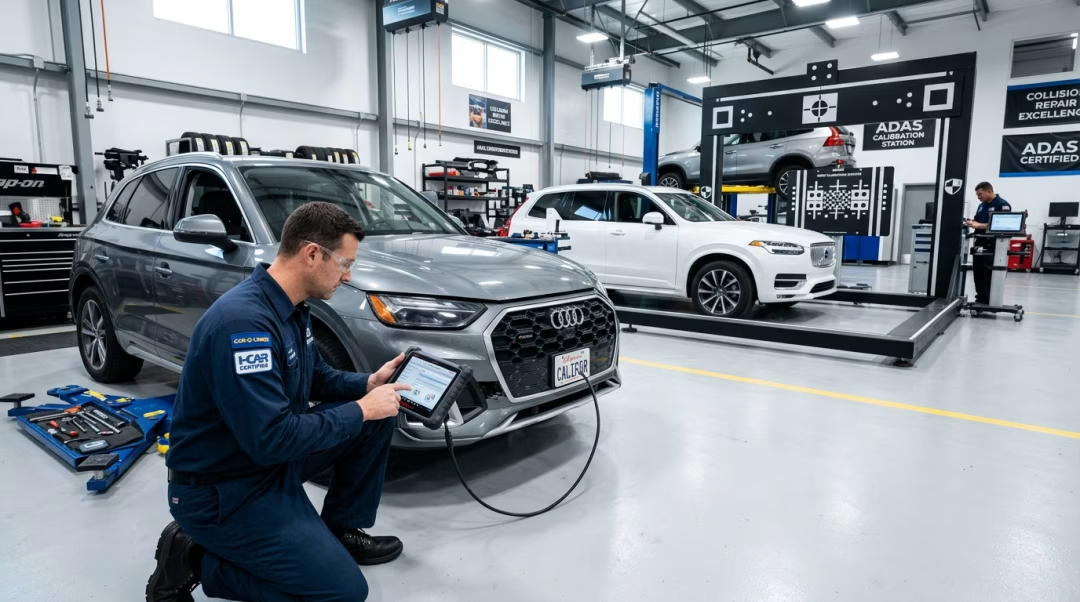
Perhaps the most complex aspect of modern collision repair is managing Advanced Driver-Assistance Systems (ADAS). These systems use a suite of sensors, cameras, radar, and lidar to power features like automatic emergency braking, lane keeping assist, blind spot monitoring, and adaptive cruise control. Even minor physical work can disrupt their precise alignment.
- A windshield replacement requires recalibrating the forward facing camera that controls lane departure warnings and emergency braking.
- A new bumper cover or even a minor repair can misalign radar sensors used for adaptive cruise control.
- A side mirror replacement necessitates recalibrating the camera for blind spot monitoring and 360 degree view systems.
- A simple wheel alignment can affect the steering angle sensor, which is vital for lane keeping assist and stability control.
As explained in our article on how sensors and cameras are recalibrated, this process is not optional. A sensor that is off by a single degree can fail to detect a hazard or apply the brakes at the wrong time, potentially causing another accident. Shops use specialized targets and software to perform both static (in shop) and dynamic (on road) calibrations, ensuring each sensor's field of view is perfectly aligned with the vehicle's centerline according to manufacturer specifications.
Final Verification: The Post Repair Inspection
Once all physical repairs and calibrations are complete, the job is still not finished. A final, post repair diagnostic scan is performed to confirm that all systems are communicating correctly and that no new trouble codes have appeared during the repair process. This final electronic handshake verifies that the vehicle's complex network is fully restored. This is followed by a thorough road test to confirm the real world performance of ADAS features. This comprehensive post repair inspection is the ultimate quality control check, guaranteeing that the vehicle is not only visually restored but is verifiably safe to drive. To learn more about our commitment to quality, you can read about our team on our about us page.
Helpful Links
- Learn what unibody repair is and why it matters for vehicle safety.
- Discover why OEM parts matter in ensuring a quality repair.
- Explore our financing frequently asked questions for payment options.
- Find out how airbag deployment damage is properly addressed.
Why is ADAS calibration necessary after a minor fender bender?
Even a minor impact can slightly shift the mounting position of a bumper, grille, or mirror where critical ADAS sensors and cameras are housed. A misalignment of just one degree can cause the system to misinterpret data, potentially disabling features like automatic emergency braking or causing them to activate incorrectly. Calibration realigns these sensors to factory specifications, ensuring they see the road accurately.
What happens if airbags are not replaced correctly after a collision?
Improper airbag replacement is extremely dangerous. It can lead to the system failing to deploy in a future accident or deploying unexpectedly. A correct repair involves replacing all deployed components with new OEM parts, including the airbag module, crash sensors, and the SRS control unit, and then clearing all fault codes to ensure the system is fully armed and functional.
Can any auto body shop work on modern vehicle safety systems?
No, not all shops are equipped to handle modern safety systems. Proper restoration requires significant investment in technician training, diagnostic scan tools, and specialized calibration equipment specific to different vehicle makes and models. It is crucial to choose a shop that can demonstrate its expertise and has the necessary tools to perform these sensitive procedures correctly.
How do I know if my car's safety features were properly restored?
A reputable collision repair shop will provide you with documentation of the work performed, including pre and post repair diagnostic scan reports. These reports show that all fault codes related to the accident were identified and subsequently cleared. They should also provide a certificate or report for any ADAS calibrations, confirming the systems were restored to manufacturer specifications.
Does insurance cover the cost of safety system recalibration?
In most cases, yes. Insurance companies recognize that ADAS recalibration and other safety system restorations are integral and necessary parts of a complete and safe repair. These procedures are typically considered part of the overall claim. However, it is always a good practice to confirm with your insurance adjuster that these necessary steps are included in the approved estimate.
