When your vehicle needs body work, it is easy to assume all repairs are created equal. However, the processes for repairing SUVs and trucks are fundamentally different from those for sedans. These larger vehicles are often built on a completely different type of chassis, known as body-on-frame, which contrasts with the unibody construction typical of most cars. This structural distinction is the primary reason why repair techniques vary so significantly. Furthermore, trucks and SUVs feature larger body panels, more complex suspension systems, and advanced safety features integrated into bumpers and grilles. These elements demand specialized equipment, extensive technician training, and a meticulous approach to ensure the vehicle is not only cosmetically restored but also returned to its original state of structural integrity and safety. Choosing a shop that understands these nuances is critical for a proper and lasting repair.
The distinct size, weight, and construction of trucks and SUVs introduce unique challenges into the collision repair process. From the initial damage assessment to the final paint application, every step requires a different perspective than a standard sedan repair. Technicians must handle oversized panels, work with reinforced frames built for towing and hauling, and recalibrate sensitive driver-assistance systems that are often positioned differently on larger vehicles. A repair shop must possess heavy-duty frame machines, lifts, and the diagnostic technology to properly service these robust vehicles and restore their pre-accident safety and performance.
A Deeper Dive into Truck and SUV Collision Repair
At a glance, a dent on a truck door might look the same as a dent on a sedan. However, the underlying structure and the methods required to fix it properly can be worlds apart. The rise in popularity of SUVs and trucks means that more drivers are facing the reality of repairing these larger, more complex vehicles after an accident. Understanding how these repairs differ is essential for any vehicle owner who wants to ensure their investment is protected and their family is safe on the road. The differences go far beyond simple size; they are rooted in vehicle architecture, materials science, and advanced technology.
Our team is committed to transparency and education, helping you understand what happens during the repair process. Whether you are looking at our current inventory or need work on a vehicle you already own, knowing these details empowers you to make informed decisions. Let's explore the key distinctions that set SUV and truck body repair apart from sedan repair.
The Foundational Difference: Body-on-Frame vs. Unibody Construction
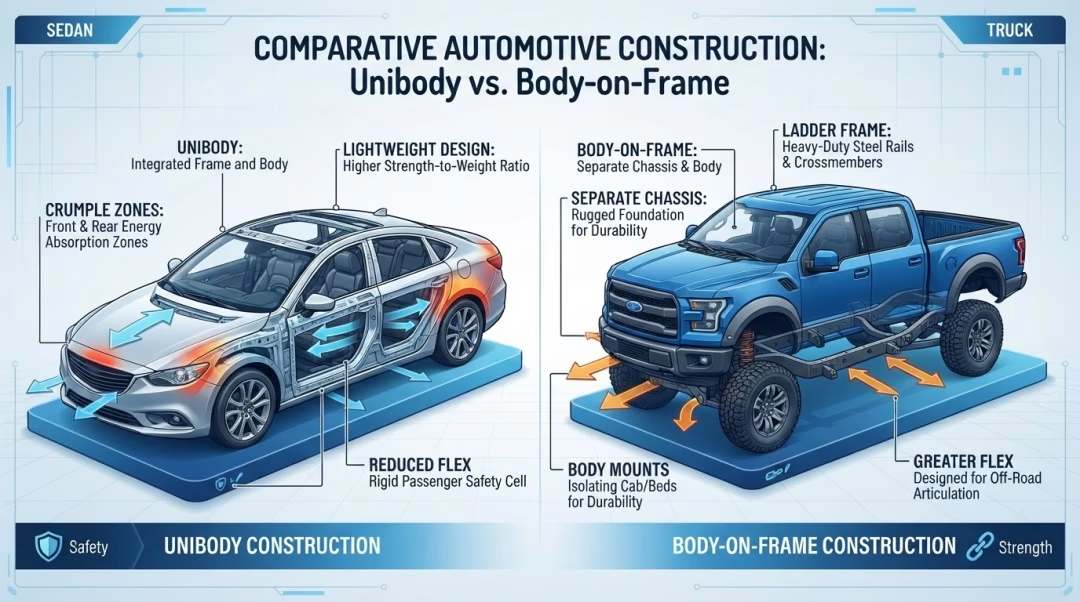
The single most significant factor that distinguishes truck and SUV repair from sedan repair is the vehicle's core structure. Most cars, crossovers, and some modern SUVs use a unibody design. In contrast, traditional trucks and many large, rugged SUVs are built using a body-on-frame design.
- Unibody Construction: In a unibody vehicle, the body and frame are integrated into a single, cohesive structure. This design is lighter and provides excellent handling and ride comfort. During a collision, the force of the impact is designed to be absorbed and distributed throughout the entire structure via crumple zones. Repairing this type of damage is a highly technical process that involves precise measurements and specialized equipment to pull the structure back into its exact factory specifications. You can learn more about what is unibody repair and why it matters on our blog. If the unibody is compromised, the vehicle's overall safety and alignment are at risk.
- Body-on-Frame Construction: Trucks and large SUVs are built with a separate body that is mounted onto a rigid, heavy-duty steel frame, often called a ladder frame. This robust design is ideal for towing, hauling heavy loads, and withstanding off-road stress. When a body-on-frame vehicle is in a collision, the frame often absorbs the majority of the force. Repairing it may involve straightening the frame on a powerful machine designed for heavy vehicles. Sometimes, damaged frame sections can be replaced. This process is entirely different from unibody work and is critical for restoring the vehicle's load-bearing capacity. Ignoring frame damage can lead to severe safety issues, which is why it is important to recognize the signs your vehicle needs structural frame repair.
Panel Size, Materials, and Repair Techniques
The sheer scale of trucks and SUVs impacts the repair process. A hood, door, or fender on a full-size truck is significantly larger and heavier than its counterpart on a compact sedan. This requires more technicians to handle and install panels, as well as specialized stands and equipment to prevent warping or damage during the repair and painting phases. The process for how fender damage is repaired on a large steel truck fender versus a small composite sedan fender involves different tools and techniques.
Furthermore, modern trucks are increasingly using advanced materials to reduce weight and improve fuel efficiency without sacrificing strength. The aluminum alloy body of the Ford F-150 is a prime example. Repairing aluminum is not the same as repairing steel. It requires a dedicated, isolated repair environment to prevent cross-contamination, as well as specialized welding and bonding equipment. Technicians must undergo specific training to work with these materials, as improper repair can compromise the panel's strength.
Impact on Suspension and Drivetrain
A collision that is severe enough to cause body damage on a truck or SUV can easily transfer significant force to its robust suspension and drivetrain components. These vehicles are engineered for heavy use, with stronger control arms, shocks, and axles. While durable, these parts are not invincible. A key part of the post-collision inspection process for a truck is a thorough examination of the suspension system, steering linkage, and frame mounts. Even minor-looking body damage can mask underlying issues that cause alignment issues after a collision, leading to uneven tire wear, poor handling, and unsafe driving conditions.
Recalibration of Advanced Driver-Assistance Systems (ADAS)
Today's vehicles are packed with sophisticated safety technology. Trucks and SUVs, often used as family haulers, are no exception. These systems, known as ADAS, rely on a network of sensors, cameras, and radar units located in the bumpers, grille, mirrors, and windshield. After body work, such as a bumper repair or replacement, it is absolutely essential that these systems are recalibrated. On a truck, a grille-mounted radar for adaptive cruise control might be positioned higher than on a sedan, affecting its calibration angle. A technician must know how sensors and cameras are recalibrated after body repair using specific targets and diagnostic software to ensure they function correctly. A misaligned sensor could fail to detect an obstacle, rendering a critical safety feature useless.
The Art and Science of Painting Larger Vehicles
Painting a large vehicle presents its own set of challenges. The vast, flat surfaces of a truck's doors, hood, and bed sides make any paint imperfection highly visible. Achieving a flawless, factory-quality finish requires a pristine, climate-controlled paint booth large enough to accommodate the vehicle and state-of-the-art equipment. The process of auto paint color matching technology is critical, as a slight variation in color will be much more noticeable across a large panel. Painters must be highly skilled in blending techniques to ensure a seamless transition between the repaired area and the original factory paint, preserving your vehicle's appearance and resale value.
Frequently Asked Questions
Is it more expensive to repair body damage on a truck than a sedan?
Generally, yes. The increased cost is due to several factors, including larger and more expensive parts, the need for specialized heavy-duty equipment for frame straightening, and potentially longer labor times for handling large panels and performing complex ADAS recalibrations. The use of special materials like aluminum can also add to the repair cost.
What is the biggest difference between repairing a unibody SUV and a body-on-frame truck?
The primary difference lies in how structural damage is addressed. For a unibody SUV, the focus is on pulling the integrated frame and body structure back to precise factory dimensions. For a body-on-frame truck, the repair often involves separating the body from the frame to work on the heavy steel frame independently, which may require straightening or section replacement.
Do aluminum truck bodies require special repair techniques?
Absolutely. Aluminum has no "memory" like steel, so it cannot be repaired using the same dent removal techniques. It also requires specific welders, rivet guns, and bonding adhesives. To prevent galvanic corrosion, steel tools cannot be used on aluminum panels, necessitating a completely separate set of tools and a dedicated, isolated repair area.
Why is ADAS recalibration so important after truck or SUV body repair?
ADAS systems like automatic emergency braking, lane-keeping assist, and blind-spot monitoring rely on perfectly aligned sensors. A slight misalignment after a bumper is replaced or a mirror is changed can cause the system to misinterpret data, potentially failing to prevent an accident or engaging at the wrong time. Recalibration ensures these vital safety features work as intended.
Can a small dent on a truck lead to bigger problems if not repaired correctly?
Yes. A seemingly minor dent can crack the paint and clear coat, exposing the metal underneath to moisture and leading to rust. On a body-on-frame truck, even a small impact can transfer energy and cause unseen stress or misalignment to frame mounting points or suspension components, which could develop into more serious issues over time.
