After a collision, the safety and integrity of your vehicle depend entirely on the quality of the repair. But how can you be sure the shop you choose is truly qualified? The answer lies in their certifications. These are not just decorative plaques on a wall; they represent a profound commitment to ongoing training, investment in advanced equipment, and adherence to the latest manufacturer-approved repair procedures. Choosing a certified shop means entrusting your vehicle to technicians who have proven their expertise in handling complex modern materials like high-strength steel and aluminum. It ensures that critical safety systems, such as airbags and advanced driver-assistance systems (ADAS), are restored to their pre-accident condition. When you see certifications from industry leaders like I-CAR and ASE, or specific automaker approvals, you can have confidence that the repair will be done right, preserving your vehicle’s value, performance, and most importantly, your safety on the road.
Think of certifications as a shop’s report card. They provide third-party validation that the facility and its technicians have met rigorous standards for knowledge and skill. In an industry where vehicle technology changes rapidly, this continuous education is essential. An uncertified shop might use outdated techniques that could compromise your vehicle's structural integrity or the function of its safety features. By prioritizing certified collision repair, you are making the single most important decision to guarantee a safe, high-quality, and lasting restoration of your vehicle after an accident.
Decoding the Most Important Auto Body Certifications
When you start looking for a reputable collision repair facility, you will likely encounter a variety of logos and acronyms. Understanding what they mean is crucial for making an informed decision. Not all certifications are created equal, and some are far more significant than others. Below, we break down the key credentials that signify a shop’s dedication to excellence and proper repair protocols.
I-CAR Gold Class: The Industry Benchmark for Training
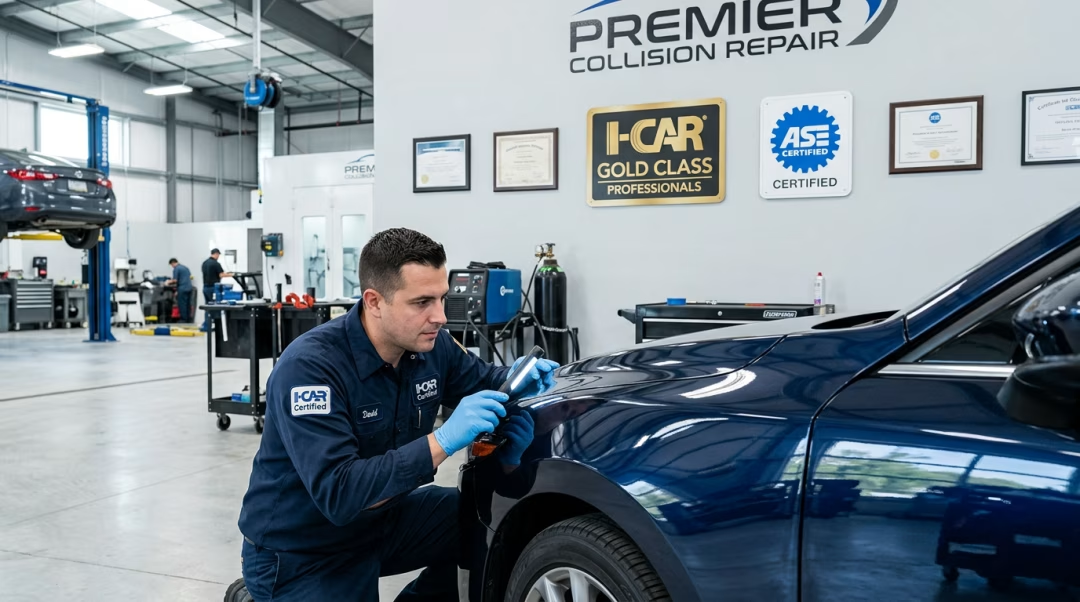
If there is one certification to look for above all others, it is I-CAR Gold Class. I-CAR, the Inter-Industry Conference on Auto Collision Repair, is a non-profit organization dedicated to providing education and training to the collision repair industry. A shop that has earned the Gold Class designation is in the top tier of collision facilities. This means its technicians have undergone extensive, role-relevant training to master the latest repair techniques. To maintain this status, they must continue their education annually, ensuring they are always up-to-date on new vehicle technologies and materials. This commitment is vital for properly repairing today's complex vehicles, where a mistake could affect everything from panel gaps to the deployment of your airbags. When you see the I-CAR Gold Class logo, you know the shop has invested heavily in its team's knowledge.
ASE Certification: The Mark of a Skilled Technician
While I-CAR focuses on the shop as a whole, the National Institute for Automotive Service Excellence (ASE) certifies the skills of individual technicians. You have likely seen the blue and white ASE seal at mechanical repair shops, but it is just as important in the collision repair world. To become ASE-certified, technicians must have at least two years of hands-on experience and pass a rigorous exam. For collision repair, relevant certifications include:
- B2: Painting & Refinishing
- B3: Non-Structural Analysis & Damage Repair
- B4: Structural Analysis & Damage Repair
- B5: Mechanical & Electrical Components
A technician who holds these certifications has proven their competency in specific, critical areas of the repair process. A shop that employs a high percentage of ASE-certified technicians demonstrates a commitment to individual expertise.
OEM (Original Equipment Manufacturer) Certifications
Perhaps the most demanding credentials a shop can earn are OEM certifications. These come directly from the automakers, such as Ford, Honda, GM, and Subaru. To become a certified repair facility for a specific brand, a shop must invest in the exact tools and equipment the manufacturer uses in their factories. Their technicians must also complete brand-specific training on the unique materials and procedures for that automaker's vehicles. This is especially important for luxury brands and vehicles with aluminum bodies or advanced safety systems. An OEM certification ensures that the shop knows precisely how to restore your vehicle to its factory specifications, using the right parts and methods. This directly impacts your vehicle's safety, performance, and warranty.
Why Certified Shops Are the Only Choice
Choosing a certified repair shop is not about paying more; it is about protecting your investment and your personal safety. Modern vehicles are not just metal and paint; they are complex networks of sensors, computers, and advanced materials. An improper repair can have serious consequences.
- Safety First: Certified shops know how to handle advanced driver-assistance systems (ADAS), ensuring cameras and sensors are recalibrated correctly. They also understand how to perform structural repairs, like frame straightening, that maintain the integrity of your vehicle's crumple zones.
- Quality and Durability: From expert paint matching to seamless panel alignment, the training required for certification results in a higher quality, visually appealing, and more durable repair.
- Resale Value: A documented, certified repair helps protect your vehicle's resale value. A poor repair job can be easily spotted by a potential buyer or trade-in appraiser, significantly lowering its worth.
- Peace of Mind: Knowing that your vehicle was repaired by qualified professionals according to industry and manufacturer standards provides invaluable peace of mind when you get back behind the wheel.
Helpful Links
Learn more about the collision repair process and our commitment to quality.
- Discover why OEM parts matter in collision repair
- Understand what happens during a collision repair estimate
- Find out more about our company and our values
- Ask our experts a question by visiting our contact us page
What is the single most important certification for a collision repair shop?
While all certifications are valuable, the I-CAR Gold Class designation is often considered the industry's gold standard. It signifies a shop-wide commitment to continuous training and education on the latest vehicle technologies and repair procedures, which is essential for safely and effectively repairing modern cars.
Are all technicians at a certified shop individually certified?
Not necessarily. Certifications like I-CAR Gold Class are awarded to the business based on the collective training of its staff. However, these shops are required to have a certain number of technicians with specific I-CAR credentials. ASE certifications, on the other hand, are awarded to individual technicians, so it is always a good idea to ask how many ASE-certified technicians a shop has on staff.
Does my insurance company require me to use a certified shop?
Generally, you have the right to choose your own repair shop. While an insurance company might have a list of "preferred" or "direct repair program" shops, they cannot force you to use one. Choosing a certified shop, even if it is not on their list, ensures you are prioritizing the quality and safety of your repair, which is always in your best interest.
Do certifications affect the cost of a collision repair?
The cost of a repair is primarily determined by the extent of the damage, labor hours, and the price of parts. While a certified shop may have higher overhead due to investments in training and equipment, they often work more efficiently and prevent costly mistakes. The cost difference is usually minimal, and the value received in terms of safety and quality far outweighs any minor price variation.
How can I verify a shop's certifications?
Reputable shops will proudly display their certification logos in their office and on their website. You can also verify their status independently. I-CAR has an online shop locator for Gold Class facilities, and you can confirm a technician's ASE certification through the ASE website. For OEM certifications, you can often check the automaker's official website for a list of approved collision centers.
